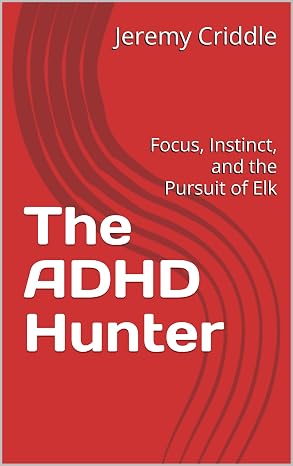
Most books about ADHD start from what’s wrong with your brain. This one starts from what’s right with it. The ADHD Hunter reframes the traits that get labeled as too much — the restlessness, the hyperfocus, the constant scan for what’s next — as instincts built for the hunt, not flaws to be managed.
There’s Real Science Behind the Reframe
This isn’t just a nice metaphor. It’s called the hunter-gatherer theory of ADHD, and there’s genuine research behind it. Genomic studies suggest ADHD-associated traits persisted through human evolution because they conferred real advantages in exactly the kind of dynamic, unpredictable environment a hunt actually is — not a classroom, not an office, a hunt. Novelty-seeking, quick threat response, constant environmental scanning: these aren’t distractibility in the field, they’re the job.
Hyperfocus is the trait that surprises people most. In a hunter-gatherer’s daily life, hyperfocus was largely self-regulating — you locked onto the thing that mattered because the environment made it obvious what mattered. Tracking an animal for hours, reading the terrain, staying still and alert for as long as it takes: that’s hyperfocus doing exactly what it evolved to do. The mismatch isn’t in the brain. It’s between that brain and a modern world built around sitting still and sustaining attention on things that don’t naturally hold it.
Why the Field Works When the Desk Doesn’t
I didn’t figure any of this out from a textbook. I figured it out hunting elk and mule deer in the West, noticing that the same brain that couldn’t sit through a meeting could track sign for six hours straight without losing the thread. The restlessness that gets labeled a problem indoors is exactly the alertness that makes you good at reading a ridge line or catching movement at the edge of your vision. The book is the story of putting that together — what it actually feels like to realize your brain was never the problem, just aimed at the wrong target most of the time.
The Specific Research This Draws On
The hunter-gatherer reframe has a name: the Hunter vs. Farmer hypothesis, first proposed by Thom Hartmann in his book Attention Deficit Disorder: A Different Perception. Hartmann himself has been upfront that it started as a mental model, not a peer-reviewed theory — “it’s not hard science, and was never intended to be.” The genomic piece is more concrete: a 2008 study led by Northwestern University anthropologist Dan Eisenberg, published in BMC Evolutionary Biology, looked at the DRD4 gene’s 7-repeat allele — already linked to novelty-seeking and ADHD symptoms — in Kenya’s nomadic Ariaal people. Men carrying that allele were better nourished than their non-carrying relatives in the nomadic group, but worse nourished than their counterparts in a settled, farming branch of the same tribe. Same gene, opposite outcome, depending entirely on which environment it landed in.
Who This Book Is For
Readers newly diagnosed or long suspecting they have ADHD who are tired of being told to just try harder. Hunters and outdoorsmen who’ve felt like their brain and the modern world were built for different jobs. Anyone who’d rather read a firsthand account than a clinical guide. It’s not for readers looking for medical advice, a diagnostic tool, or a treatment plan — this is one person’s lived reframe, grounded in real research, not a substitute for a doctor.
What’s In the Book
The ADHD Hunter is Book 1 of the ADHD Hunter & Runner Series, and it lays the foundation for everything that follows: a way of seeing an ADHD brain as built for pursuit, pattern-reading, and total presence in the field, instead of something to apologize for. Written from firsthand experience, not a clinical textbook. If you’ve spent your life being told to sit still and focus harder, this book makes the case that your brain was never the problem.
“Your mind wasn’t built for the classroom. Or the office. Or the checklist. It was built for the hunt… This isn’t a manual. It’s a field guide for those who’ve been told to sit still, calm down, and fit in. It reframes ADHD not as a flaw, but as a primal advantage — one that can be trained, sharpened, and unleashed.”
From the book’s official description
112 pages. Reading age 12-18. Published August 2025.
Free to read with Kindle Unlimited, or available to buy outright — check current pricing on Amazon.