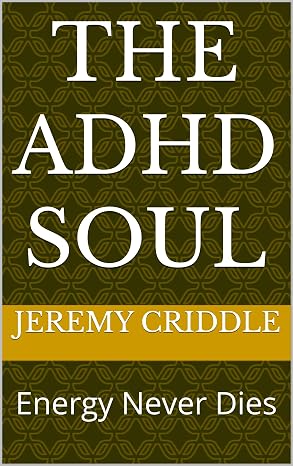
The ADHD Soul: Energy Never Dies

The ADHD Soul book cover

Book 4 is the most ambitious entry in the series — a big-picture theory of ADHD, autism, and other neurodivergent minds as specialized types of consciousness that have shown up throughout human history, not modern deficiencies. The ADHD Soul is a thought experiment as much as a self-help book: what if the traits we pathologize today were exactly what let earlier civilizations survive and build?

The Mismatch Theory, Taken Seriously

There’s a real, published line of research behind this idea, often called the mismatch theory: many modern psychological conditions may stem from a discord between the environments our brains were shaped by and the environments we actually live in now. Novelty-seeking, impulsivity, heightened alertness, distractibility as constant environmental scanning — researchers studying hunter-gatherer societies have found these traits conferred real, measurable advantages: faster threat response, better foraging outcomes, the flexibility to do a little bit of everything a small, mobile group actually needed. ADHD has one of the highest heritability rates of any psychiatric condition, 60 to 80 percent by most estimates — which is itself a strange thing for a trait to have if it were purely a disorder with no adaptive upside at any point in human history.

None of this argues ADHD is costless in a modern classroom or office — it clearly isn’t, and pretending otherwise doesn’t help anyone. What it argues is that the cost is about mismatch with a specific, historically recent environment, not evidence the brain itself is broken.

Where the Book Goes Further

This is where the series stops being about personal strategy and starts asking a bigger question: if these traits were genuinely adaptive for most of human history, what does that mean for how we should think about neurodivergent minds today — not as a deficit to manage down to baseline, but as a different, historically load-bearing way of processing the world. It’s a thought experiment more than a clinical argument, and it’s written that way — for readers who’ve already read the first three books and want the bigger idea sitting underneath all of it.

Who This Book Is For

Readers who’ve already read the first three books and want the bigger idea sitting underneath them. People drawn to evolutionary psychology or philosophy of mind as much as self-help. This is not the place to start the series — it assumes you already have the practical grounding from Books 1 through 3 — and it’s not a self-help book in the conventional sense either; it says so itself, this is a thought experiment first.

What’s In the Book

This is the philosophical center of the series — less a how-to and more a reframe of the whole premise, for readers ready to go past the practical books into the theory underneath them.

“What if consciousness itself is running out?… As population explodes and consciousness spreads thin across 8 billion people, we’re left with what the author calls ‘placeholder souls’ — minds running on basic programming, going through the motions of modern life without real purpose or awareness. The neurodivergent aren’t broken — they’re the last concentrated remnants of humanity’s original design.”

From the book’s official description

200 pages. Reading age 15-18. Published September 2025.

Free to read with Kindle Unlimited, or available to buy outright — check current pricing on Amazon.


← Back to Book 3  |  Continue to Book 5, The ADHD Rulebook →