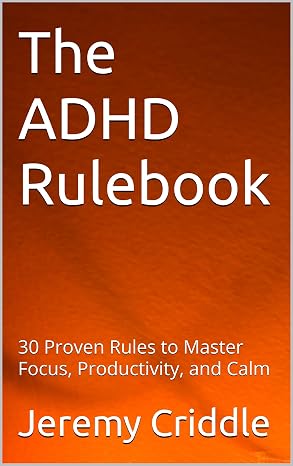
The most practical book in the series: 30 direct, no-nonsense rules for working with an ADHD brain instead of against it, addressing the real neuroscience — irregular dopamine signaling, time blindness, executive dysfunction — instead of generic “try harder” advice repackaged for neurodivergent readers.
Time Blindness Is Real, and It’s Not About Effort
Time blindness — the inability to reliably sense how much time has passed or estimate how long something will actually take — isn’t a character flaw, it’s a documented feature of how ADHD affects the brain. Dopamine plays a direct role in temporal processing, not just motivation, and when dopamine regulation is disrupted, so is the brain’s ability to track time accurately. Adults with ADHD tend to operate on what researchers describe as two modes: NOW and NOT NOW. A deadline three days out doesn’t feel real until it’s suddenly today. That’s not a discipline problem. It’s a genuinely different relationship with time, and it needs different tools than “just be more aware,” which is advice that assumes the exact thing that’s broken is still working fine.
Executive Dysfunction Is the Real Term for “Can’t Get Started”
Executive function covers planning, prioritizing, and shifting between tasks — and it depends heavily on prefrontal cortex activity, a region that’s structurally and functionally different in ADHD brains. That’s the actual mechanism behind knowing exactly what needs to happen and still being completely unable to start it. It’s not laziness, and calling it that just adds shame on top of a real cognitive difference without fixing anything underneath it.
Written From the Inside, Not About It
The ADHD Rulebook is written in the same voice as the rest of the series: someone who lives with this brain, not someone studying it from the outside. Thirty rules, direct and specific, built around what actually helps when time blindness and executive dysfunction are the real obstacle — not vague encouragement, not another productivity system built for a brain that doesn’t work this way.
Who This Book Is For
Readers who want practical rules right now, without wading through narrative or theory first. It’s also a reasonable entry point into the whole series — thirty direct rules are a fast way to test whether this approach fits before committing to the rest. It’s not for readers who prefer memoir, or who want the full reasoning behind each rule spelled out at length — that’s what Books 1 through 4 are for; this one is deliberately built for speed.
What’s In the Book
Thirty direct rules addressing the real mechanisms — dopamine, time blindness, executive dysfunction — with no generic self-help padding. The most immediately usable book in the series if you want practical rules over philosophy or narrative.
A Few of the 30 Rules
- Map your dopamine patterns to schedule tasks during your natural peak performance windows
- Curb impulses using a pause-and-count technique that gives your prefrontal cortex time to actually engage
- Direct hyperfocus toward productive projects instead of losing hours to whatever randomly grabs your attention
- Build momentum through immediate micro-win celebrations that feed a reward-deficient dopamine system
Each rule comes with the neuroscience behind why it works for ADHD brains specifically, concrete implementation steps, and troubleshooting for when a strategy needs adjusting — not just a list of tips.
279 pages. Reading age 15-18. Published October 2025.
Free to read with Kindle Unlimited, or available to buy outright — check current pricing on Amazon.
← Back to Book 4 | Start from the beginning: Book 1, The ADHD Hunter →